Using AI in your research? SEBI says disclose it — and you own the output
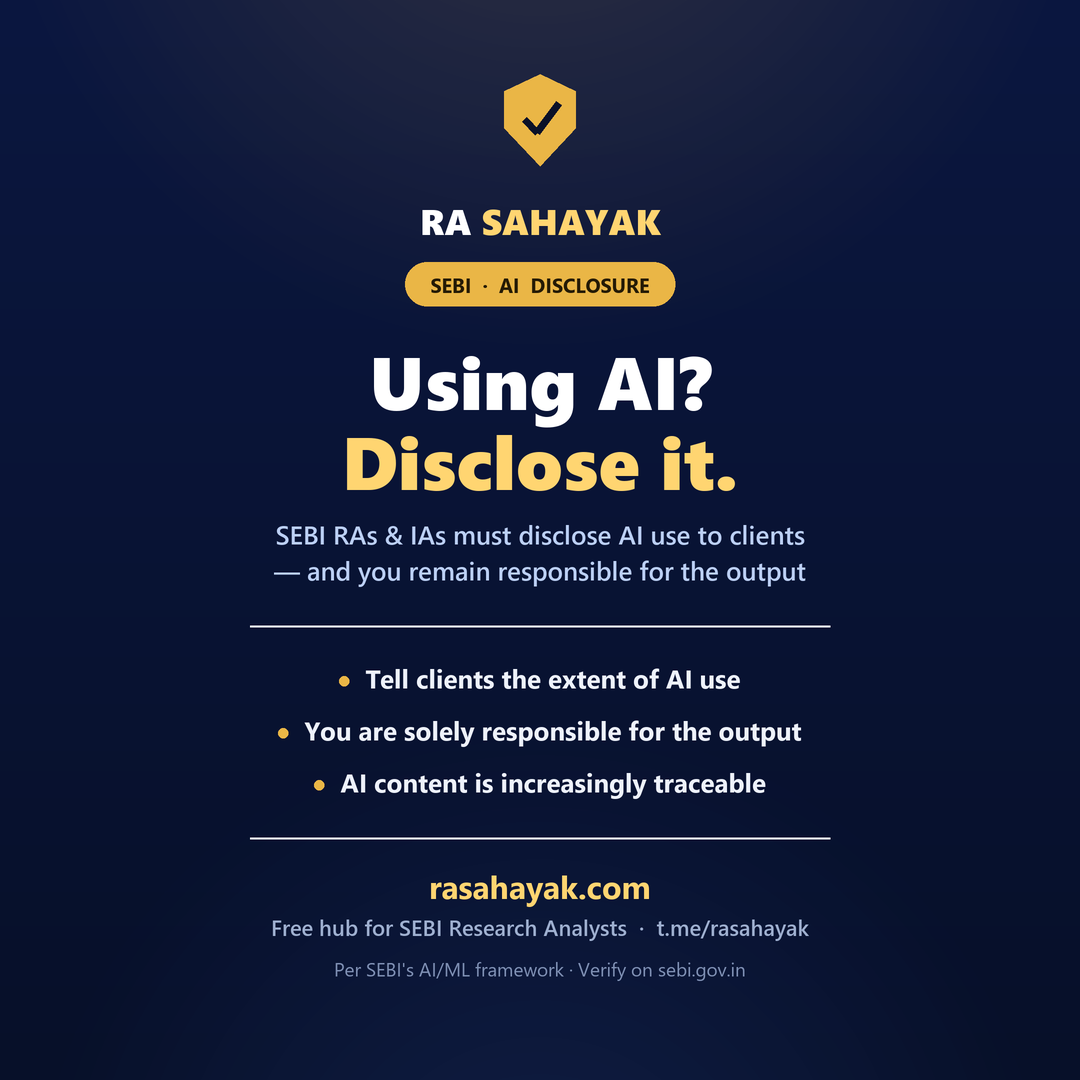
If you use AI tools — ChatGPT, Claude, Gemini or any other — to help produce research or advice, SEBI expects you to disclose the extent of that AI use to your clients, and it holds you solely responsible for the output, the data security and the compliance. On top of that, AI-generated content is becoming increasingly traceable. Here's the plain-English picture for every SEBI Research Analyst (RA) and Investment Adviser (IA).
Always confirm the exact, current requirement on sebi.gov.in →
What SEBI requires from RAs & IAs on AI
- Disclose the extent of AI use. If you use AI tools in servicing clients, you must give clients complete disclosure of the extent of that use — so they can make an informed decision about continuing with you. Make the disclosure at the time of the agreement and update it as needed; existing clients were to be informed by 30 April 2025.
- You are solely responsible. SEBI is unambiguous: responsibility for data security, client confidentiality, the integrity of the AI output, and regulatory compliance lies solely with the RA/IA — irrespective of the scale or scenario of AI use, and whether the tool is built in-house or bought from a vendor.
- Governance & oversight. SEBI's June 2025 consultation on responsible AI/ML expects human oversight, sound model governance, testing in a segregated environment before deployment, fallback plans, and proper agreements with third-party AI vendors.
In short: AI can assist you, but the research, the advice and the accountability remain yours.
Why “invisible marks” matter: AI content is increasingly traceable
A fast-growing ecosystem now makes it possible to tell whether a piece of content was produced or edited with AI:
- C2PA “Content Credentials” — ratified as an ISO standard (ISO/IEC 22144) in 2025 — attach a signed, tamper-evident record of the tool/model that produced an image, audio or video and every edit made to it.
- Durable watermarks such as Google's SynthID embed an invisible signal into the content — for images, audio, video and, in some cases, text — that survives ordinary edits.
- The Content Authenticity Initiative now counts thousands of members (Google, Microsoft, Adobe, Meta, OpenAI and many more), and major AI providers are adopting layered provenance.
Be accurate about the limits: not every AI tool watermarks every kind of output today, and provenance signals can sometimes be stripped or lost (e.g. via screenshots or format changes). But the direction of travel is one-way. The safe assumption for a regulated professional is simple: treat AI-assisted work as identifiable, and be transparent rather than try to hide it. Combined with SEBI's disclosure rule, quietly passing off AI output as fully human is both a compliance risk and a reputation risk.
What every SEBI RA / IA should do
- Add an AI-use disclosure to your client agreement and, ideally, your website — stating the extent to which AI tools assist your research/advice.
- Keep a human in the loop. Review, verify and edit every AI output; you take responsibility for it. AI drafts — you decide and sign off.
- Protect client data. Don't feed client personal or confidential information into public AI tools without proper safeguards and contracts — data security is on you.
- Maintain records of which AI tools you use and how you review their output, so you can evidence oversight.
- Never let AI make the call blindly. Use it to speed up drafting and analysis, not to replace your own reasoned judgement and disclosures.
- Vet your vendors. If you use a third-party AI product, ensure the contract covers data handling, security and your regulatory obligations.
FAQs
More for SEBI Research Analysts
Post-Reg Compliance
The full 16-step checklist every SEBI RA must complete.
Open checklist →Compliance Calendar
Every recurring RA deadline — audit, filings & more.
Open calendar →SEBI Circulars & PRs
Auto-updated, RA-relevant circulars & press releases.
Open circulars →Join our Telegram
Free live SEBI alerts & updates for RAs and IAs.
Join now →RA Sahayak is free & ad-free. A small UPI tip keeps it maintained. 😊
Disclaimer
This post is a plain-English summary for awareness and is compiled with the help of AI — in the spirit of the very transparency it describes. It is for general information only and is not legal, compliance, tax, or investment advice.
SEBI's AI/ML framework is evolving; some elements were at consultation stage. Always read the official SEBI communications and verify the exact, current requirement from the official sources (sebi.gov.in / bseindia.com), or consult a qualified professional, before acting. RA Sahayak is a free, non-commercial resource and is not affiliated with SEBI, BSE, or any regulator.