Get your “@valid” UPI ID by 6 October 2026 — BSE clarifies for RAs
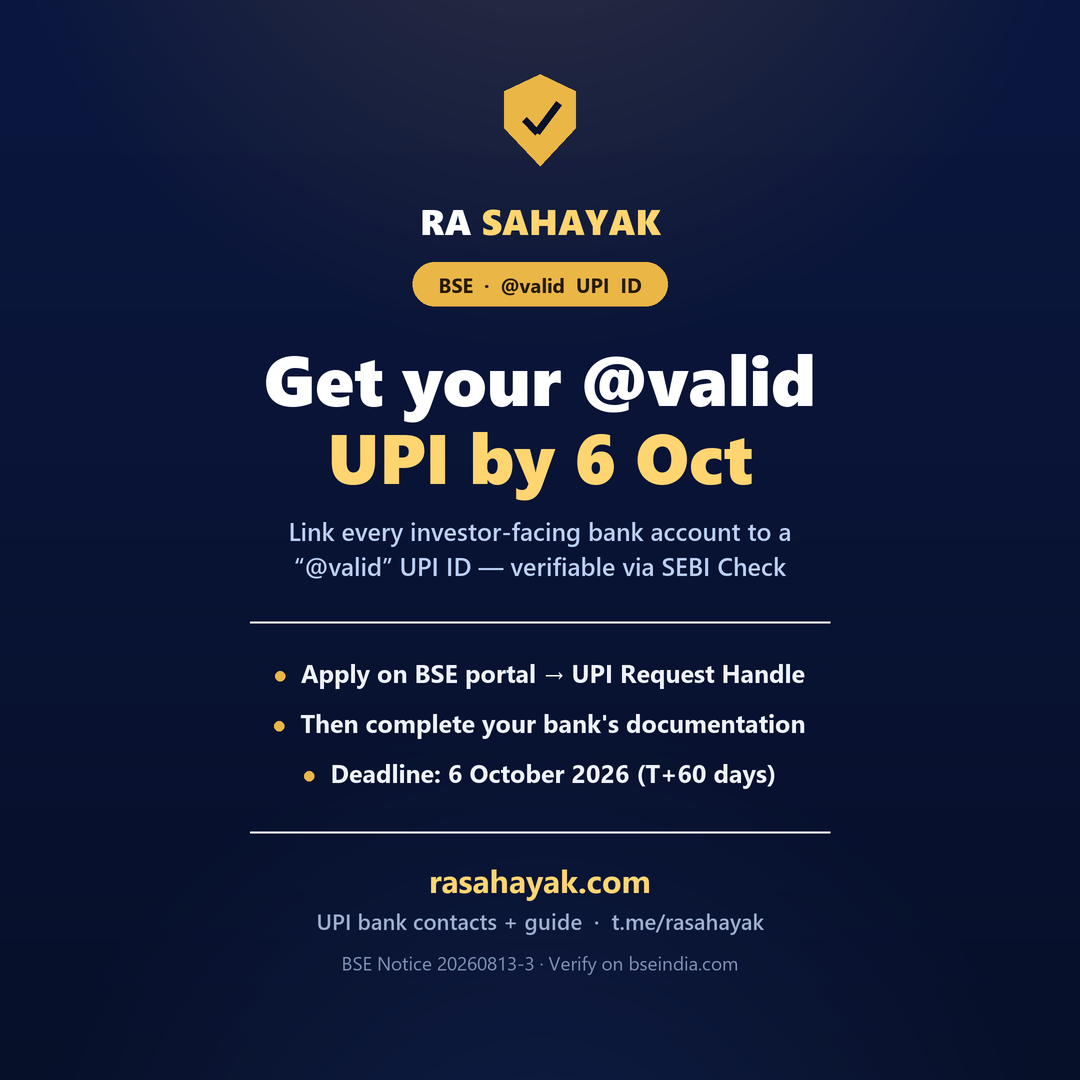
BSE (RAASB) has issued a clarification on how Research Analysts must implement SEBI's “@valid” UPI IDs. In short: every investor-facing bank account you use to collect fees must be linked to a “@valid” UPI ID — so it's verifiable through SEBI Check — and you must do it by 6 October 2026.
Based on: SEBI Circular SEBI/HO/DEPA-II/DEPA-II_SPG/P/CIR/2025/86 (11 Jun 2025) & Exchange Notice 20250908-19 (8 Sep 2025); with a fresh SEBI clarification dated 7 August 2026 (clarification in Annexure A, FAQs in Annexure B).
What's required
- Link every investor-facing bank account — any account through which you receive funds from individual / non-institutional investors — to a “@valid” UPI ID.
- This ensures each such account is verifiable through SEBI Check (so investors can confirm they're paying a genuine, SEBI-registered RA).
- New accounts too: any new investor-facing bank account you open later must also be linked to a “@valid” UPI ID.
How to apply — step by step
- 1. Log in to the BSE portal via iaraportal.sebi.gov.in.
- 2. Go to BSE portal → “UPI Request Handle” and submit your request.
- 3. Once your UTN is generated, approach your bank to complete the documentation/process for the “@valid” UPI handle.
Need the right person at your bank? Our UPI Banks contact list has the bank-wise details (KYC, bank statement & RA certificate are typically needed).
What the SEBI FAQ clarifies — for RAs
SEBI's clarification letter (7 Aug 2026, Dept. of Economic & Policy Analysis) comes with a 21-point Standard FAQ for Intermediaries. Here's what actually matters for a Research Analyst:
- Which accounts count. Any bank account that is both directly visible to an investor and may receive money from an individual / non-institutional investor — for an RA, that's your fee-collection account, and any account whose number or QR code you share with clients for payment.
- Which don't. Internal operational, settlement, treasury, vendor-payment, salary, undisclosed pool and payment-aggregator escrow accounts are not covered — anything an investor isn't expected to pay into directly.
- One “@valid” UPI ID per account. Each investor-facing account needs its own “@valid” UPI ID — a single ID cannot cover multiple accounts.
- You needn't actually collect through every one. The goal is verifiability on SEBI Check, not routing. Extra “@valid” UPI IDs may stay disabled for inward UPI (subject to your bank), and you can keep collecting through your preferred ID. Offline “@valid” UPI IDs are fine where the bank permits.
- NEFT / RTGS / IMPS / bank transfer still work. No payment mode is restricted — investors can keep paying any permitted way. The catch: the destination account must be verifiable on SEBI Check.
- Inactive & new accounts. An account not receiving investor money needs nothing now — but it must get a “@valid” UPI ID before it's ever used to receive investor funds, and so must any new collection account you open.
- After the deadline. From 6 Oct 2026, receive investor funds only into accounts that are verifiable on SEBI Check.
- The simple test (Q16). If an investor can directly transfer money into the account, it must be verifiable through SEBI Check.
- No new obligation beyond the circular. This clarification supplements (does not amend) the 11 Jun 2025 circular; for issuance/activation issues, coordinate with your sponsor / partner bank.
More for SEBI Research Analysts
UPI Banks
Bank-wise contacts to create your “@valid” UPI handle.
Open list →Compliance Calendar
Every recurring RA deadline in one place.
Open calendar →SEBI & BSE Updates
Auto-updated, RA-relevant circulars & notices.
Open circulars →Join our Telegram
Free live SEBI & BSE alerts for RAs and IAs.
Join now →RA Sahayak is free & ad-free. A small UPI tip keeps it maintained. 😊
Disclaimer
This post is a plain-English awareness summary, compiled with the help of AI. It is for general information only and is not legal, compliance, tax, or investment advice.
Always read the full official BSE Notice 20260813-3 and its Annexures, and verify the exact requirement and dates from the official sources (bseindia.com / sebi.gov.in), or consult a qualified professional, before acting. RA Sahayak is a free, non-commercial resource and is not affiliated with SEBI, BSE, or any regulator.